
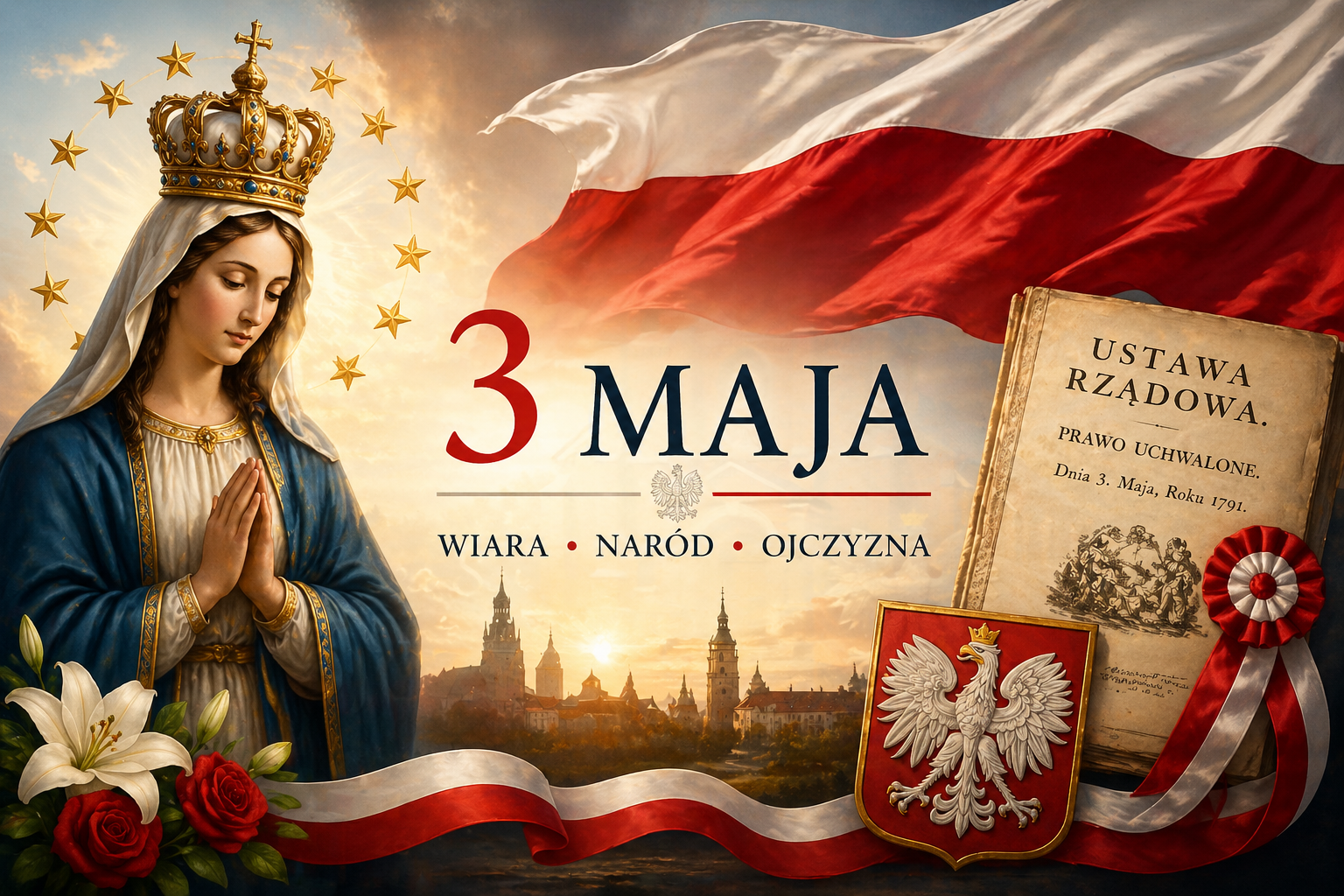
3 maja 2026 r. Polacy obchodzą podwójne święto, które od ponad stu lat tworzy nierozerwalną jedność polskiej wiary i polskiego patriotyzmu. Tego dnia Kościół wspomina Matkę Bożą Królową Korony Polskiej, a naród obchodzi rocznicę uchwalenia Konstytucji 3 Maja 1791 roku – pierwszego w Europie i drugiego na świecie dokumentu ustrojowego tego typu. Oba te wydarzenia, choć dzieli je ponad sto trzydzieści lat, mówią o tym samym: Polska przetrwa tylko wtedy, gdy będzie wierna Bogu i swojej tożsamości.
Uchwalona 3 maja 1791 roku przez Sejm Czteroletni Konstytucja była aktem desperacji i geniuszu. W obliczu groźby całkowitego unicestwienia Rzeczypospolitej przez Rosję, Prusy i Austrię grupa polskich patriotów – wśród nich król Stanisław August Poniatowski, marszałek Sejmu Stanisław Małachowski, Ignacy Potocki i Hugo Kołłątaj – postanowiła przeprowadzić radykalną reformę ustroju. Zniesiono liberum veto, wprowadzono dziedziczność tronu, oddzielono władzę ustawodawczą, wykonawczą i sądowniczą, a także nadano miastom prawa polityczne. Była to próba ratowania niepodległości przez wzmocnienie państwa.
– Konstytucja 3 Maja jest ostatnim aktem woli narodu polskiego przed rozbiorami – mówił później książę Józef Poniatowski.
Dokument ten został jednak natychmiast zaatakowany przez Rosję i konfederację targowicką. W 1794 roku Tadeusz Kościuszko podjął heroiczną próbę obrony reform, walcząc pod hasłem „Ojczyzna i Wolność”. Przegrana insurekcja kościuszkowska przypieczętowała los Polski na sto dwadzieścia trzy lata.
Równolegle z tym narodowym dramatem rozwijała się duchowa historia Polski. 1 kwietnia 1656 roku król Jan Kazimierz, po cudownym ocaleniu przed szwedzkim potopem, złożył w katedrze lwowskiej uroczyste śluby. Przed obrazem Matki Bożej Łaskawej ogłosił Maryję Królową Korony Polskiej i oddał Jej w opiekę całą Rzeczpospolitą. Było to aktem głębokiej wiary i politycznej mądrości – król uznał, że tylko pod opieką Nieba Polska może przetrwać.
W 1920 roku, w niepodległej już Polsce, papież Benedykt XV oficjalnie ustanowił 3 maja liturgicznym wspomnieniem Matki Bożej Królowej Korony Polskiej. W bulli „Quod iam diu” Ojciec Święty napisał, że Maryja, która przez wieki strzegła Polski, ma prawo do tego tytułu. W 1962 roku papież Jan XXIII potwierdził i rozszerzył to święto, nadając Maryi tytuł Królowej Korony Polski.
Od tego czasu 3 maja stał się w Polsce dniem, w którym wiara i ojczyzna spotykają się w jednym akcie oddania. W kościołach odprawia się uroczyste Msze święte, a na placach miast odbywają się parady i akademie. W okresie międzywojennym święto to obchodzono z niezwykłą pompą – maszerowały wojsko, harcerze, organizacje kombatanckie. W czasach PRL komuniści próbowali je zdegradować do zwykłego święta państwowego, usuwając z obchodów element religijny. Po 1989 roku 3 maja powrócił do swojej pierwotnej, podwójnej formy.
W 2026 roku, gdy Europa i świat przeżywają głęboki kryzys tożsamości, znaczenie tego dnia jest szczególnie aktualne. Konstytucja 3 Maja przypomina, że prawdziwa wolność nie polega na braku zasad, lecz na mądrym ustroju opartym na prawie Bożym i prawie naturalnym. Śluby lwowskie Jana Kazimierza uczą, że Polska nie jest tylko tworem ludzkim – jest dziełem Opatrzności, powierzonym opiece Matki Bożej.
W Nowym Dworze Mazowieckim i na terenie całego powiatu nowodworskiego 3 maja 2026 r. obchody będą miały charakter szczególnie uroczysty. O godzinie 10.00 w kościele pw. św. Michała Archanioła w Nowym Dworze odprawiona zostanie Msza święta w intencji Ojczyzny. Po nabożeństwie wierni przejdą pod Pomnik Obrońców Ojczyzny, gdzie złożą wieńce i kwiaty. O godzinie 12.00 na Rynku w Nowym Dworze odbędzie się akademia patriotyczna z udziałem pocztów sztandarowych szkół i organizacji kombatanckich. Wieczorem, o godzinie 19.00, w Kasynie Oficerskim w Twierdzy Modlin zaplanowano koncert pieśni patriotycznych w wykonaniu Zespołu Pieśni i Tańca Ziemi Nowodworskiej „Soli Deo”.
Tego dnia rano (godz. 9:00) w Bazylice Archikatedralnej w Warszawie zostanie odprawiona Msza Święta w intencji Ojczyzny z udziałem Pary Prezydenckiej, Prezydenta Karola Nawrockiego i Małżonki . Odbędzie się uroczystość wręczenia odznaczeń państwowych i wystąpienie prezydenta na Zamku Królewskim. O godz. 12:00 na Placu Zamkowym zaplanowano składanie wieńców i podniesienie flagi.
– 3 maja to nie tylko święto historyczne. To dzień, w którym każdy Polak powinien zapytać siebie: co ja robię dla Polski? – mówił w ubiegłym roku podczas podobnych obchodów płk w st. spocz. Alfred Kabata, prezes Zarządu Głównego Związku Oficerów Rezerwy RP.
W duchu polskiej tradycji katolickiej i patriotycznej 3 maja przypomina nam, że Polska nie przetrwa bez dwóch filarów: żywej wiary i silnego, sprawiedliwego państwa. Matka Boża Królowa Polski i Konstytucja 3 Maja 1791 roku to nie dwa oddzielne święta – to jedno, nierozerwalne dziedzictwo, które zobowiązuje kolejne pokolenia do wierności Bogu, Ojczyźnie i prawdzie.
Niech więc 3 maja 2026 r. będzie dla nas wszystkich dniem głębokiej refleksji i odnowienia ślubów – tych złożonych przez Jana Kazimierza w 1656 roku i tych, które każdy z nas nosi w sercu jako Polak i katolik.
3 May – Our Lady Queen and the Constitution, two pillars of Polish identity
On 3 May 2026 Poles celebrate a double feast that for over a hundred years has formed an inseparable unity of Polish faith and Polish patriotism. On this day the Church commemorates Our Lady Queen of the Polish Crown, while the nation marks the anniversary of the Constitution of 3 May 1791 – the first constitutional document of its kind in Europe and the second in the world. Although these two events are separated by more than one hundred and thirty years, they speak of the same truth: Poland will survive only if it remains faithful to God and its identity.
The Constitution adopted on 3 May 1791 by the Four-Year Sejm was an act of desperation and genius. Faced with the threat of total annihilation of the Commonwealth by Russia, Prussia and Austria, a group of Polish patriots – including King Stanisław August Poniatowski, Sejm Marshal Stanisław Małachowski, Ignacy Potocki and Hugo Kołłątaj – decided to carry out a radical reform of the political system. They abolished the liberum veto, introduced hereditary monarchy, separated the legislative, executive and judicial powers, and granted political rights to the towns. It was an attempt to save independence by strengthening the state.
– The Constitution of 3 May is the last act of the will of the Polish nation before the partitions – Prince Józef Poniatowski later said.
However, the document was immediately attacked by Russia and the Targowica Confederation. In 1794 Tadeusz Kościuszko made a heroic attempt to defend the reforms, fighting under the motto “For Faith and Fatherland”. The defeat of the Kościuszko Uprising sealed Poland’s fate for one hundred and twenty-three years.
Parallel to this national drama, Poland’s spiritual history was unfolding. On 1 April 1656, after the miraculous deliverance from the Swedish Deluge, King Jan Kazimierz made solemn vows in Lwów Cathedral. Before the image of Our Lady of Grace he proclaimed Mary Queen of the Polish Crown and entrusted the entire Commonwealth to Her protection. It was an act of deep faith and political wisdom – the king recognised that only under the care of Heaven could Poland survive.
In 1920, in already independent Poland, Pope Benedict XV officially established 3 May as the liturgical commemoration of Our Lady Queen of the Polish Crown. In the bull “Quod iam diu” the Holy Father wrote that Mary, who for centuries had guarded Poland, had the right to this title. In 1962 Pope John XXIII confirmed and extended the feast, giving Mary the title Queen of Poland.
Since then 3 May has become in Poland a day when faith and fatherland meet in one act of dedication. Solemn Masses are celebrated in churches, and parades and academies are held in city squares. In the interwar period the feast was celebrated with extraordinary pomp – the army, scouts and veterans’ organisations marched. During the PRL period the communists tried to downgrade it to an ordinary state holiday, removing the religious element from the celebrations. After 1989, 3 May returned to its original, double form.
In 2026, when Europe and the world are experiencing a deep identity crisis, the significance of this day is particularly relevant. The Constitution of 3 May reminds us that true freedom does not consist in the absence of principles, but in a wise political system based on divine law and natural law. The Lwów vows of Jan Kazimierz teach us that Poland is not merely a human creation – it is the work of Providence, entrusted to the protection of Our Lady.
In Nowy Dwór Mazowiecki and throughout the Nowy Dwór Mazowiecki County, the celebrations of 3 May 2026 will be particularly solemn. At 10.00 a.m. a Holy Mass for the Fatherland will be celebrated in the Church of St. Michael the Archangel in Nowy Dwór. After the service the faithful will proceed to the Monument to the Defenders of the Fatherland, where wreaths and flowers will be laid. At 12.00 noon a patriotic academy with colour parties from schools and veterans’ organisations will take place in the Market Square in Nowy Dwór. In the evening, at 7.00 p.m., a concert of patriotic songs performed by the Song and Dance Ensemble of the Land of Nowy Dwór “Soli Deo” is planned at the Officers’ Casino in the Modlin Fortress.
– 3 May is not only a historical holiday. It is a day when every Pole should ask himself: what am I doing for Poland? – said last year during similar celebrations Col. (ret.) Alfred Kabata, President of the Main Board of the Union of Reserve Officers of the Republic of Poland.
In the spirit of Polish Catholic and patriotic tradition, 3 May reminds us that Poland will not survive without two pillars: living faith and a strong, just state. Our Lady Queen of Poland and the Constitution of 3 May 1791 are not two separate feasts – they are one, inseparable heritage that obliges successive generations to be faithful to God, the Fatherland and the truth.
May 3 May 2026 therefore be for all of us a day of deep reflection and renewal of vows – those made by Jan Kazimierz in 1656 and those that each of us carries in our heart as a Pole and a Catholic.


