Dedykuję ten tekst Robertowi z Żyrardowa, memu „duchowemu bratu”, i podobnym do niego „smutnym katolikom”, którzy nie wierzą w to, że w Kościele… „idzie wiosna”…
Wiosna Kościoła w „Kraju Środka”
Wstęp
W pewnym kołchozie w Kazachstanie, w połowie lat 50., ludzie zebrali się w prywatnym domu na modlitwę. Na czatach wokół domu stała grupa chłopców, by dać sygnał, gdyby w okolicy pojawił się jakiś szpicel czy milicjant.
Starsza kobieta zabrała ze sobą pięcioletniego wnuka Antosia. W pomieszczeniu było duszno i mały zaczął grymasić i płakać.
„Nie płacz, tylko słuchaj. Popatrz na tego kapłana. On do nas przyjechał z daleka i ryzykował życiem. Jeśli go złapią, mogą go aresztować i zabić. On dla nas ryzykuje życie, a tobie się nudzi i płaczesz”.
Babcia była dla chłopca autorytetem. Kiedy dostrzegł, z jakim szacunkiem babcia opowiada o kapłanie, w swoim sercu natychmiast zdecydował:
„CHCĘ BYĆ TAKI JAK ON”.
Spotkałem go w 1992 r. w Wołgogradzie podczas poświęcenia małej kaplicy zbudowanej z kontenerów. Był już kapłanem grubo po pięćdziesiątce i towarzyszył biskupowi z Moskwy jako jego wikariusz generalny.
Za jakiś czas został rektorem seminarium w Petersburgu, a na starość przeniósł się do Brześcia Litewskiego, gdzie budował kościół. Dziś ma zapewne około 80 lat i być może przeszedł na emeryturę…
Podczas obiadu u proboszcza w Wołgogradzie pokazał mi wiszącą tam mapę świata i rzekł:
„TERAZ KOŚCIÓŁ ODRADZA SIĘ W ROSJI, A POTEM ODRODZI SIĘ W CHINACH I WSZĘDZIE TAM, GDZIE BYŁ KOMUNIZM”.
Ksiądz Antoni Hej to niepoprawny optymista. Jestem trochę od niego młodszy, ale w „sprawach dotyczących wiary” mam podobny do niego charakter. Zarówno on, jak i ja jesteśmy dwoma „niepoprawnymi marzycielami”.
Marzę, a nawet wierzę, że świat nie ma innej opcji. Ludzkość wkrótce powróci do Boga, nawet w takich krajach, w których nam się to nie śniło.
Proszę posłuchać, co zobaczyłem na własne oczy w Pekinie 20 lat temu.
1. Dzielnica Baobao
Jest w Pekinie dzielnica Baobao. Byłem tam 20 lat temu. Jest tam piękna i nowiutka świątynia prezbiteriańska, najprawdopodobniej sponsorowana przez bogatych Koreańczyków, bo w Korei właśnie prezbiterian jest sporo. Na sąsiedniej ulicy stoi nie mniej piękny budynek katolickiego seminarium.
Dotarłem tam w towarzystwie mojego lekarza terapeuty o nazwisku Fan. Przyjechaliśmy autobusem numer 333 i ten numer mnie zauroczył. Myślę, że nawet dziś trafiłbym tam bez pudła.
Porozumiewaliśmy się głównie językiem migowym lub z pomocą 50 chińskich słów, jakie znałem, zanim trafiłem do Chin.
Co ciekawe, rektorem był „młodszy ode mnie chłopak” po studiach w USA, rodak mojego doktora Fana, pochodzący z diecezji Xianxian w prowincji Hebei, 100 km na południe od Pekinu.
Gdy się dowiedziałem, że ma tylko 30 studentów, wyraziłem swoje rozczarowanie. Uspokoił mnie, że jest to seminarium wyłącznie na potrzeby miasta, które jest diecezją.
Wyobrażasz to sobie???
W komunistycznym Pekinie funkcjonuje diecezja, która 20 lat temu miała 33 kleryków. Idę o zakład, że dziś jest ich dużo więcej.
Wokół Pekinu jest jeszcze 10 diecezji w prowincji Hebei, która rozciąga się wokół stolicy. W tamtym czasie miały one swoje oddzielne „międzydiecezjalne seminarium”, w którym 20 lat temu studiowało 800 kleryków.
Dodam, że do 1949 r. w Pekinie misje prowadzili misjonarze lazaryści, zaś wokół stolicy jezuici, a wśród nich słynny antropolog Teilhard de Chardin. Odsetek katolików w Pekinie jest niewielki, a mimo to było tam 25 kościołów oficjalnie zarejestrowanych jako kościoły patriotyczne.
Szacuje się, że połowa katolików nadal uczęszcza na tajne zebrania Kościoła podziemnego.
Zaznaczam, że moja wiedza opiera się na danych orientacyjnych sprzed 20 lat.
Oficjalnie mówiło się wtedy o 25 milionach katolików w całych Chinach. Jeśli pomnożyć tę liczbę przez dwa, uzyskamy cyfrę, która może spowodować wypieki na twarzy.
W Chinach już dziś jest najprawdopodobniej więcej katolików niż w Polsce…
Czyż nie jest to wiosna Kościoła?
Gdy rektor seminarium opowiedział mi o 800 klerykach na przedmieściach Pekinu, na moment osłupiałem…
2. „Neńka Ukraina”, czyli: nie ma złego, co by na dobre nie wyszło
Wyjaśnię, że trafiłem do Chin nie jako misjonarz, lecz jako pacjent, aby uniknąć dializ i spróbować zreperować nerki po strasznej diagnozie, jaką jest „zapalenie kłębuszkowe”.
Gdybym tego nie zrobił 20 lat temu, wiedziony intuicją, dziś bym już nie żył, bo ze sztuczną nerką mało kto żyje więcej niż 20 lat… Średnia krajowa: 15.
Nie będę opisywał wszystkich perypetii. Dość na tym, że na Donbasie sąsiadami księży chrystusowców i sióstr urszulanek w Doniecku byli rodowici Chińczycy z Charbina.
Zapoznałem się z nimi na rok przed tym, zanim zachorowałem. Pobierałem za drobną opłatą lekcje chińskiego. Mój nauczyciel nazywał się Wan Yu Men, pochodził z Mandżurii i był emerytowanym inżynierem górnikiem, który po studiach w ZSRR ożenił się z Ukrainką i pozostał na Donbasie.
Pewnego razu przyszedł do mnie bardzo sfrustrowany i otworzył przede mną swoją duszę. Był zdesperowany.
Pomogłem swemu nauczycielowi powrócić do Chin, bo pożyczył ode mnie pieniądze na bilet. Tam znalazł dobrą pracę jako pośrednik budowlany…
Werbował chińskich robotników do budowy Astany, nowej stolicy Kazachstanu. Pomogła mu w tym perfekcyjna znajomość rosyjskiego i chińskiego, a zwłaszcza terminologii technicznej…
Gdy wrócił na Donbas, by zabrać żonę z córką, dowiedział się o mojej chorobie, więc za poradą lekarzy z Doniecka zabrał również mnie.
To taka dygresja, by w pełni wyjaśnić, jak się stało, że trafiłem do Chin na pół roku.
Pojechałem za zgodą biskupa diecezji charkowsko-zaporoskiej, w której wówczas pracowałem.
3. Diecezja Xianxian w prowincji Hebei
Opowiem, jak dotarłem do jednej z tych 10 diecezji w prowincji Hebei na 10 dni, podczas obchodów tak zwanej Rewolucji Październikowej.
Komuniści przejęli władzę w Chinach w 1949 r., właśnie w październiku, i w kalendarzu tego kraju jest 10 dni wolnych od pracy…
W miasteczku Huo Dziang mieszka zaledwie 10 tys. mieszkańców. O dziwo, sto procent ludności to katolicy.
Mój lekarz Fan pochodził właśnie z tych okolic. Pojechaliśmy zwykłym autobusem, a kierowca, widząc, że mam pod szyją koloratkę, nie wziął opłaty za przejazd.
Zamieszkaliśmy u jego kuzyna, który był zaprzyjaźniony z księżmi. Dzięki temu byłem jak „swój człowiek” i miałem wszędzie drzwi otwarte.
Po sąsiedzku znajduje się podobnej wielkości miasteczko Xianxian, stolica diecezji.
Tamtejszy biskup senior siedział na placu katedralnym na wózku inwalidzkim i próbował ze mną gawędzić po łacinie.
Po chwili nadjechał młodszy biskup. Przedstawił się swoim katolickim imieniem: Józef.
Miał zaledwie trzydzieści kilka lat. Jak wszyscy księża w Chinach był biedny, jeździł na rowerze, ale pięknie mówił po angielsku, bez żadnych kompleksów wobec mnie.
Niczego się nie bał i poświęcił mi dobre pół godziny na pogawędkę.
Byłem w szoku po tym spotkaniu, bo księża w Pekinie, poza rektorem seminarium w Baobao, byli wobec mnie nieufni. Miałem wrażenie, że się mnie obawiali, i tylko jeden z nich zaprosił mnie na herbatę.
Tutaj, na prowincji, katolicy byli bardziej otwarci i odważni.
4. Moje dorywcze duszpasterstwo
Jako człowiek chory nie czyniłem żadnych prób, by angażować się w tutejsze misje.
Odwiedziłem kilkanaście kościołów w Pekinie jako zwykły wierny albo turysta. Muszę powiedzieć, że żaden z tych kościołów nie był pusty. Wszystkie pękały w szwach, zwłaszcza w niedzielę.
Dla porównania: świątynie konfucjańskie, jakie napotkałem w centrum Pekinu, zostały zamienione na muzea i nie pełnią już roli świątyń.
Nie napotkałem też żadnego meczetu, mimo że w Pekinie jest mnóstwo ujgurskich herbaciarni z arabskimi szyldami. Muzułmanie owszem, są.
Słyszałem jednak, że władze chińskie określają islam jako schorzenie natury psychicznej i zamykają meczety wszędzie, gdzie się da.
Kościoły katolickie natomiast mają proboszczów, są odremontowane i dobrze zaopatrzone.
Jeden zgrzyt polega na tym, że proboszczowie są tu zatrudnieni nie w charakterze zarządców, lecz „płatnych robotników”.
Zarząd parafii i kontrolę nad pieniędzmi sprawuje rada parafialna, która z kolei rozlicza się i donosi partii komunistycznej o wszystkim, co dzieje się w kościele.
To jedna z przyczyn tego, że Kościół podziemny nadal jest popularny.
Wiedząc o tym, nie naprzykrzałem się proboszczom, „żeby im nie zaszkodzić”.
Opatrznościowo jednak niektórzy odważniejsi kapłani sami zaproponowali mi koncelebrę.
Jeden raz odprawiałem w katedrze Nan Tang, czyli w „Południowej Świątyni”. To katedra zbudowana za czasów słynnego jezuity, astronoma i wykładowcy Matteo Ricciego. Zaprzyjaźnił się on z cesarzem, który ze środków państwowych i na swojej działce w dawnym centrum Pekinu pozwolił zbudować ten kościół.
Wygląda pięknie i ma ponad 400 lat.
Dwie kolejne Msze odprawiłem w prowincji Hebei.
Na przykład w dzień św. Tereski miałem kazanie w kościele w Huo Dziang, gdzie młody proboszcz znalazł dla mnie tłumacza i pozwolił odprawić Mszę koncelebrowaną oraz opowiedzieć o patronce misjonarzy.
Pięciuset ludzi słuchało mnie z ogromnym zaciekawieniem.
5. Cudowne zdarzenie w „wiejskiej katedrze”
 Potem poproszono mnie o kazanie na dzień Matki Bożej Różańcowej w dużej wiosce, skąd pochodził doktor Fan.
W kościele, gdzie zebrało się ponad 1000 osób, nie była to koncelebra, ale Msza po łacinie, którą celebrowałem tym razem sam, na prośbę proboszcza. On tymczasem wyjechał do innego kościoła.
Mszał był przedsoborowy, ołtarz również.
Nigdy z takiego mszału nie odprawiałem ani przedtem, ani potem…
Intuicyjnie wyszukiwałem potrzebne rubryki i czułem w sercu, że „powinno się udać”, bo jak nas uczył w dawnych czasach w seminarium pewien znany rekolekcjonista i biskup, w chwilach trudnych i wątpliwych: „Ecclesia supplet” — Kościół dopełnia niedostatki wiedzy swoich grzesznych, chorych lub niedouczonych kapłanów.
Wzruszające wspomnienia.
Nigdzie ludzie nie modlą się tak pięknie jak w tym regionie.
Dodam, że tego dnia na wsi nie było prądu. Kościół był wielki jak katedra w Białymstoku albo jak kościół św. Floriana na warszawskiej Pradze — również neogotycki.
Wieśniacy od końca lat 40. lub 50., czyli od czasu wybuchu „rewolucji kulturalnej”, nie widzieli białego misjonarza. Po Mszy ustawili się w kolejce, by uścisnąć mi dłoń. Wielu z nich całowało mnie w ręce, jak na prymicji.
Wyszedłem na podwórko zszokowany.
Nie potrzebowałem latarki, była śliczna pełnia.
Msza zaczęła się o 20.00, a zakończyła o 21.30.
Tym razem nie miałem tłumacza, więc nie było kazania. Odprawiałem jednak powoli, pobożnie i, gdzie się dało, sam śpiewałem. Tam, gdzie nie było to możliwe, ludzie sami śpiewali wszystkie dialogowane kwestie.
Pieśni na wejście, offertorium, komunię i zakończenie również były śliczne, ale po chińsku.
Dla Roberta, jako tradycjonalisty, mam dobrą wiadomość: łacina w Chinach to nie problem.
Zarówno w Pekinie, jak i na prowincji Msze łacińskie są nadal popularne. Ludzie znają ministranturę.
Paradoksalnie, tak jak w Polsce czy w ZSRR, liturgiczne zmiany posoborowe docierały do Chin z wielkim opóźnieniem, co w efekcie wyszło im na dobre.
Profesor Wydra, mój wykładowca psychologii, pedagogiki i homiletyki, lubił powtarzać na wykładach:
„Proszę księży, proszę kolegów, zapamiętajcie moje słowa: jeszcze będziemy dziękować komunistom, że za ich czasów Kościół rozkwitał w Polsce”.
Być może te słowa mają jakiś sens nawet w odniesieniu do Chin.
Prześladowania są, ale nie odnoszą pożądanego skutku.
Chińczycy kochają Kościół katolicki, są wierni i „mają łacinę w paluszku”.
Ponieważ większość misjonarzy na tym terenie stanowili Francuzi, ich łacina miała francuski odcień, czyli śliczny romański akcent.
Dodam, że osiem lat później trafiłem do Oceanii i przeżyłem tam déjà vu…
W wielu papuaskich wioskach napotkałem chóry, które potrafią śpiewać po łacinie, mimo że połowa ich członków nie potrafi czytać…
Taki fenomen wierności tradycji.
6. Opowieść biskupa Józefa
Biskup Józef z Xianxian miał katedrę takich rozmiarów jak w Licheniu. Gdy spytałem, jak mu się to udało, powiedział:
„Komuniści nas zdopingowali”.
„Jakim cudem?” — zapytałem.
„Parę lat wcześniej zburzyli nam naszą małą katedrę, więc zrobiliśmy zrzutkę, daliśmy «prezent» pierwszemu sekretarzowi i zbudowaliśmy nową, ale większą, wedle naszych potrzeb”.
„Jak to możliwe?” — znowu zapytałem. „Nie boicie się, że wam znowu ją zburzą?”
„Jak zburzą, to znowu zrobimy zrzutkę… Nasi sekretarze są z katolickich rodzin i muszą udawać, że nas prześladują, ale tak naprawdę każdy z nich nam sympatyzuje i w ukryciu również pielęgnuje w sercu wiarę”.
Czy to ci nic nie przypomina?
W Polsce też byli tacy „pseudokomuniści”, którzy w dzień przeszkadzali, a wieczorem przed snem odmawiali zdrowaśki…
7. Seminarium Teilharda de Chardina
W seminarium zaczytywałem się powieściami słynnego jezuity i antropologa, który na pustyni Gobi odszukał szkielety wielu dinozaurów, ale większość czasu spędzał w miasteczku Xianxian jako profesor w seminarium.
Wzruszyłem się, że trafiłem w to samo miejsce, gdzie „mój mistrz” spędził kilkadziesiąt lat.
Odwiedziłem niższe seminarium, gdzie na potrzeby tej małej diecezji studiowało 70 kleryków, a wykładowcy byli absolwentami seminarium z Manili.
Sponsorował ich słynny kardynał Sin…
Jego nazwisko było znane z czasów, gdy w Manili trwała tak zwana „rewolucja różańcowa”.
Ponieważ popularność kardynała pomogła zwalczyć reżim Marcosa, pochlebnie pisały o nim nawet komunistyczne media.
Został kardynałem na Filipinach w latach 70., ale mało kto wie, że pochodził z Chin, i to właśnie z miasteczka Xianxian.
Dodam, że napotkałem tam jeszcze 300 zakonnic przy katedrze, które utrzymywały się z produkcji soi i sponsorowały 10 katolickich wiejskich szpitali, o których oficjalnie nikt nic nie wie.
Tak jak mało kto wiedział, na czym polegał fenomen Kościoła w PRL.
Tu postawię kropkę, by nie powiedzieć za dużo.
8. Inne kraje ościenne
Temat Kościoła w Chinach jest podobnie wrażliwy jak opowiadanie o nawróceniach w Iranie czy Arabii Saudyjskiej. To nie jest „czarna dziura” — to właśnie ta „wiosna Kościoła”, o której żaden dziennikarz nie marzył.
Zmobilizowałeś mnie, Robercie, i oto masz wspomnienia sprzed dwudziestu lat.
Ile jest jeszcze takich miejsc na świecie, gdzie wbrew rozsądkowi Kościół kwitnie pod nosem swojego zaklętego wroga Kościoła…
Tego nie wiem ani ja, ani ty.
Zapewniam cię, że w Wietnamie dzieje się jeszcze więcej takich cudów, bo — wedle przepowiedni starego księdza Antoniego Heja, rodem z Kazachstanu — odnowa Kościoła pójdzie tą samą ścieżką, którą wędrował komunizm.
Są oznaki odrodzenia w ojczyźnie Pol Pota, czyli w Kambodży, również w Angoli i na Kubie…
Są nawet w Mongolii, gdzie do niedawna jedynym wyznaniem, prócz komunizmu, był zdziesiątkowany buddyzm.
Mieszka tam obecnie kardynał, którego znam osobiście, bo jest szefem Konferencji Biskupów Azji Środkowej i pół roku temu odwiedzał Taszkent.
Epilog
Nie spodziewałem się, że moja opowieść o WIOŚNIE KOŚCIOŁA wywoła jakąkolwiek reakcję.
Myliłem się.
Jeden z moich wychowanków w Papui wyraził skruchę, że ich powołania są kruche, ale pocieszył mnie, że jest nadzieja na poprawę.
Robert z Żyrardowa natomiast, któremu dedykuję ten tekst, stwierdził, że jestem naiwny i że opisane przeze mnie sytuacje to „listek figowy na rozkładającym się trupie Kościoła”, któremu już nic nie pomoże — ani we Francji, ani w USA.
Robert użył bardziej dosadnych słów, ale ja przetłumaczyłem je po swojemu, żeby tekst można było opublikować i nie trwożyć delikatnych uszu potencjalnych czytelników.
Sięgnąłem więc jeszcze po jeden „listek figowy” — ten, który znalazłem w Chinach ku pokrzepieniu własnego serca. A może ktoś jeszcze potrzebował takiego pokrzepienia.
Pozdrawiam z Zachodnich Himalajów.
ks. Jarosław Wiśniewski FD
Uzbekistan — Angren
The Fig Leaf on a Dead Body: A Missionary’s Second Testimony
Springtime of the Church in the “Middle Kingdom”
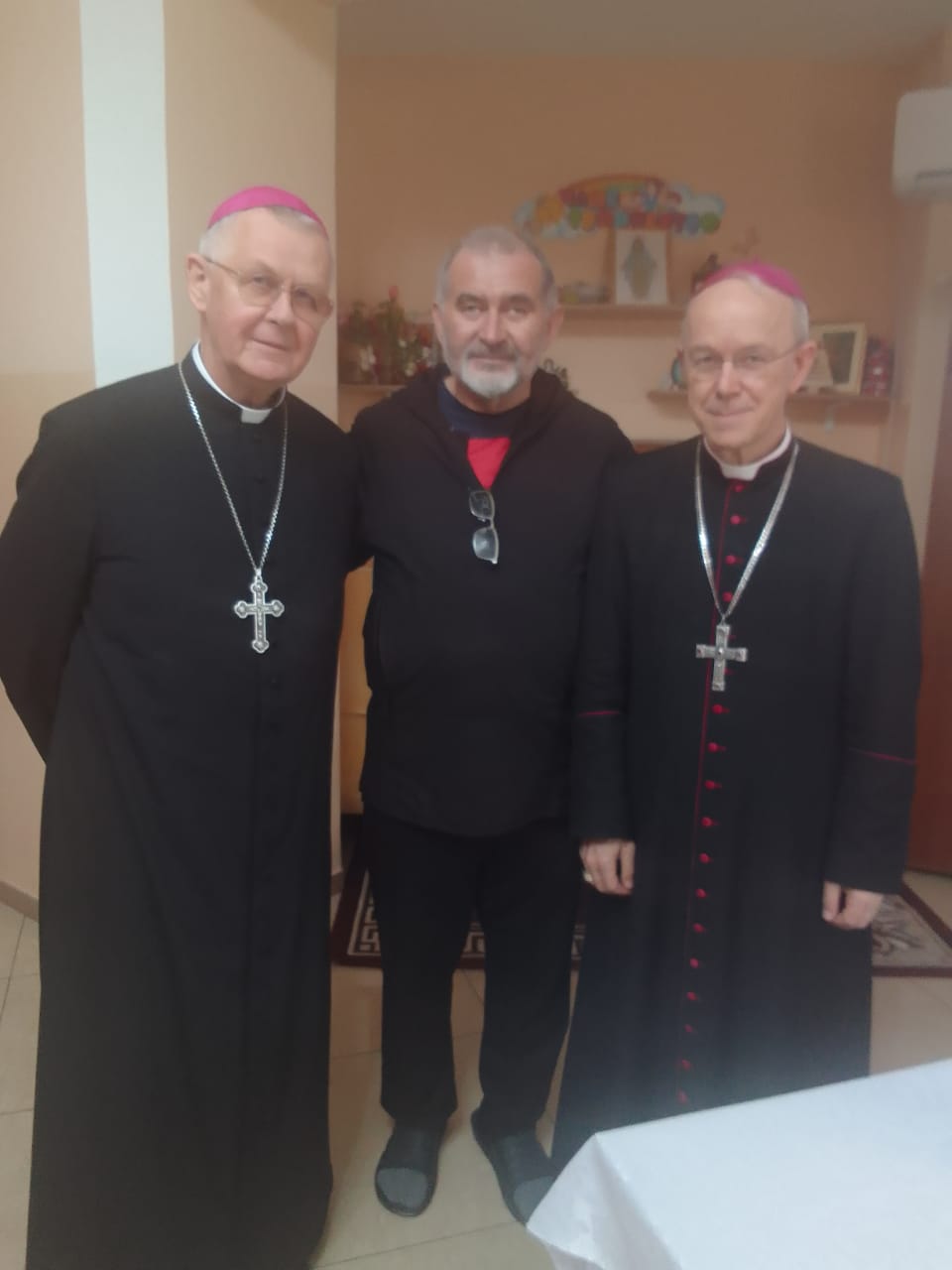
In the photograph: the author of the account (center), together with bishops from Kazakhstan: Archbishop Tomasz Peta (taller) and Bishop Alojzy Schneider (shorter).
I dedicate this text to Robert from Żyrardów, my “spiritual brother,” and to other “sad Catholics” like him, who do not believe that “spring is coming” to the Church…
Introduction
In a collective farm in Kazakhstan, in the mid-1950s, people gathered in a private home to pray. A group of boys kept watch around the house, ready to give a signal if a spy or a militiaman appeared nearby.
An elderly woman had brought her five-year-old grandson, Antoś, with her. The room was stuffy, and the little boy began to fuss and cry.
“Don’t cry. Just listen. Look at that priest. He has come to us from far away and risked his life. If they catch him, they may arrest him and kill him. He risks his life for us, and you are bored and crying.”
His grandmother was an authority figure for the boy. When he saw how respectfully she spoke about the priest, he made an immediate decision in his heart:
“I WANT TO BE LIKE HIM.”
I met him in 1992 in Volgograd, during the blessing of a small chapel built from shipping containers. He was already a priest well past fifty and was accompanying the bishop from Moscow as his vicar general.
Some time later, he became rector of the seminary in St. Petersburg. In his old age, he moved to Brest-Litovsk, where he was building a church. Today, he is probably around eighty and may have retired…
During lunch at the parish priest’s home in Volgograd, he showed me a world map hanging there and said:
“THE CHURCH IS NOW BEING REBORN IN RUSSIA, AND THEN IT WILL BE REBORN IN CHINA AND EVERYWHERE ELSE THAT HAS EXPERIENCED COMMUNISM.”
Father Antoni Hej is an incurable optimist. I am a little younger than he is, but when it comes to “matters of faith,” I have a similar temperament. Both he and I are “incorrigible dreamers.”
I dream—and even believe—that the world has no other option. Humanity will soon return to God, even in countries where we would never have imagined it.
Let me tell you what I saw with my own eyes in Beijing twenty years ago.
1. The Baobao District
There is a district in Beijing called Baobao. I was there twenty years ago. It has a beautiful, brand-new Presbyterian church, most likely sponsored by wealthy Koreans, since there are many Presbyterians in Korea. On the neighboring street stands an equally beautiful building housing a Catholic seminary.
I went there with my physician and therapist, Dr. Fan. We took bus number 333, and that number captivated me. I think I could still find my way there without a problem today.
We communicated mainly through sign language or with the help of the fifty Chinese words I knew before arriving in China.
Interestingly, the rector was a “young man younger than me” who had studied in the United States. He was a fellow countryman of my doctor, Fan, and came from the Diocese of Xianxian in Hebei Province, about sixty miles south of Beijing.
When I learned that he had only thirty students, I expressed my disappointment. He reassured me that the seminary served only the needs of the city, which was itself a diocese.
Can you imagine that?
In communist Beijing, there is a diocese that had thirty-three seminarians twenty years ago. I would bet that there are many more today.
Around Beijing, there are another ten dioceses in Hebei Province, which surrounds the capital. At that time, they had their own separate “interdiocesan seminary,” where eight hundred seminarians were studying twenty years ago.
I should add that, until 1949, the Lazarist missionaries conducted missions in Beijing, while the Jesuits worked in the areas around the capital. Among them was the famous anthropologist Teilhard de Chardin. The proportion of Catholics in Beijing is small, yet there were twenty-five churches officially registered as “patriotic churches.”
It is estimated that half of the Catholics still attend secret gatherings of the underground Church.
I emphasize that my knowledge is based on approximate figures from twenty years ago.
At the time, the official figure for all of China was twenty-five million Catholics. If that number is doubled, the result is a figure that might make one blush with astonishment.
There are probably already more Catholics in China than in Poland…
Isn’t that springtime for the Church?
When the seminary rector told me about the eight hundred seminarians in the outskirts of Beijing, I was momentarily stunned…
2. “Neńka Ukraine,” or: Every Cloud Has a Silver Lining
Let me explain that I did not go to China as a missionary, but as a patient. I wanted to avoid dialysis and try to repair my kidneys after receiving the terrible diagnosis of glomerulonephritis.
If I had not followed my intuition and done this twenty years ago, I would no longer be alive today. Few people live more than twenty years with an artificial kidney… The national average is fifteen.
I will not describe all the complications. Suffice it to say that, in the Donbas region, the neighbors of the priests of the Society of Christ and the Ursuline Sisters in Donetsk were native Chinese people from Harbin.
I had met them a year before I became ill. I was taking Chinese lessons for a small fee. My teacher was named Wan Yu Men. He came from Manchuria and was a retired mining engineer who had studied in the Soviet Union, married a Ukrainian woman, and remained in the Donbas.
One day, he came to me deeply distressed and opened his heart. He was desperate.
I helped my teacher return to China by lending him money for his ticket. There, he found a good job as a construction broker…
He recruited Chinese workers for the construction of Astana, the new capital of Kazakhstan. His excellent command of Russian and Chinese, particularly technical terminology, helped him do the job…
When he returned to the Donbas to collect his wife and daughter, he learned about my illness. On the advice of doctors in Donetsk, he took me with him as well.
That is a digression to explain fully how I came to spend half a year in China.
I went with the permission of the bishop of the Kharkiv-Zaporizhzhia Diocese, where I was working at the time.
3. The Diocese of Xianxian in Hebei Province
I will tell you how I reached one of those ten dioceses in Hebei Province for ten days, during the celebrations associated with the so-called October Revolution.
The Communists took power in China in October 1949, and the country’s calendar includes ten days off work…
The small town of Huo Dziang has only about ten thousand inhabitants. Surprisingly, one hundred percent of the population is Catholic.
My doctor, Fan, came from that area. We traveled on an ordinary bus, and when the driver saw the clerical collar around my neck, he did not charge me for the ride.
We stayed with his cousin, who was friends with priests. Thanks to that, I was treated like one of their own and doors opened for me everywhere.
Nearby is another town of a similar size, Xianxian, the seat of the diocese.
The retired bishop was sitting in a wheelchair in the cathedral square and trying to chat with me in Latin.
A younger bishop arrived a little later. He introduced himself by his Catholic name: Joseph.
He was only in his early thirties. Like all the priests in China, he was poor and rode a bicycle, but he spoke English beautifully and showed no sense of inferiority in my presence.
He was afraid of nothing and spent a good half hour talking with me.
I was astonished by this encounter because, in Beijing, the priests—apart from the rector of the seminary in Baobao—had been distrustful of me. I had the impression that they were wary of me, and only one had invited me for tea.
Here in the provinces, Catholics were more open and courageous.
4. My Occasional Pastoral Ministry
As a sick man, I made no attempt to become involved in the local missions.
I visited a dozen or so churches in Beijing, either as an ordinary worshipper or as a tourist. I must say that none of those churches was empty. They were all packed, especially on Sundays.
By comparison, the Confucian temples I encountered in central Beijing had been turned into museums and no longer served as places of worship.
I did not come across any mosques either, even though Beijing has many Uyghur teahouses with Arabic signs. Muslims are certainly present.
I had, however, heard that the Chinese authorities describe Islam as a mental illness and close mosques wherever they can.
The Catholic churches, on the other hand, have parish priests, have been renovated, and are well supplied.
There is one drawback: parish priests are employed here not as administrators but as “paid workers.”
The parish council manages the parish and controls its money. In turn, it accounts to the Communist Party and reports everything that happens in the church.
This is one of the reasons why the underground Church remains popular.
Knowing this, I did not pester parish priests, “so as not to cause them trouble.”
Providentially, however, some of the more courageous priests themselves offered to concelebrate Mass with me.
On one occasion, I celebrated Mass at Nan Tang Cathedral, or the “Southern Church.” It was built in the time of the famous Jesuit, astronomer, and scholar Matteo Ricci. He befriended the emperor, who gave permission for the church to be built on his own land in the old center of Beijing, using state funds.
It is beautiful and more than four hundred years old.
I celebrated two more Masses in Hebei Province.
For example, on the feast day of St. Thérèse, I preached at the church in Huo Dziang. The young parish priest found an interpreter for me and allowed me to concelebrate Mass and speak about the patron saint of missionaries.
Five hundred people listened to me with great interest.
5. A Miraculous Event in a “Village Cathedral”
Later, I was asked to preach on the feast of Our Lady of the Rosary in a large village from which Dr. Fan came.
More than a thousand people had gathered in the church. This was not a concelebrated Mass, but a Latin Mass that I celebrated alone at the parish priest’s request. In the meantime, he had gone to another church.
The missal was pre-Vatican II, and so was the altar.
I had never celebrated Mass using such a missal before, and I never did so afterward…
Intuitively, I searched for the necessary rubrics and felt in my heart that “it should work out.” As a well-known retreat preacher and bishop had taught us in the seminary long ago, in difficult and uncertain moments: “Ecclesia supplet”—the Church supplies what is lacking in the knowledge of her sinful, sick, or poorly instructed priests.
Moving memories.
Nowhere do people pray as beautifully as in that region.
I should add that there was no electricity in the village that day. The church was as large as the cathedral in Białystok or St. Florian’s Church in Warsaw’s Praga district; it, too, was Neo-Gothic.
The villagers had not seen a white missionary since the late 1940s or 1950s—that is, since the beginning of the “Cultural Revolution.” After Mass, they lined up to shake my hand. Many kissed my hands, as people do at a newly ordained priest’s first Mass.
I walked out into the courtyard in a state of shock.
I did not need a flashlight; there was a beautiful full moon.
Mass began at 8:00 p.m. and ended at 9:30 p.m.
This time I had no interpreter, so there was no sermon. I celebrated slowly and devoutly, singing myself wherever I could. Where I could not, the people sang all the responses in the dialogue parts themselves.
The entrance, offertory, Communion, and closing hymns were beautiful too—but they were in Chinese.
I have good news for Robert, as a traditionalist: Latin is not a problem in China.
Both in Beijing and in the provinces, Latin Masses remain popular. People know the altar servers’ responses.
Paradoxically, as in Poland and the Soviet Union, the post–Vatican II liturgical changes reached China with a considerable delay, which ultimately worked to its advantage.
Professor Wydra, my lecturer in psychology, pedagogy, and homiletics, liked to repeat during his classes:
“Dear priests, dear colleagues, remember my words: one day we will thank the Communists because the Church flourished in Poland during their time.”
Perhaps those words make some sense in relation to China as well.
Persecution exists, but it does not achieve the desired result.
The Chinese love the Catholic Church, remain faithful, and “know their Latin by heart.”
Since most missionaries in this area were French, their Latin had a French flavor—a lovely Romance accent.
I should add that eight years later I went to Oceania and experienced déjà vu there…
In many Papuan villages, I encountered choirs capable of singing in Latin, even though half their members could not read…
Such is the phenomenon of fidelity to tradition.
6. The Story of Bishop Joseph
Bishop Joseph of Xianxian had a cathedral as large as the one in Licheń. When I asked him how he had managed it, he replied:
“The Communists gave us a push.”
“How on earth?” I asked.
“A few years earlier, they demolished our small cathedral, so we took up a collection, gave the First Secretary a ‘present,’ and built a new one—larger, and suited to our needs.”
“How is that possible?” I asked again. “Aren’t you afraid they will demolish it again?”
“If they demolish it, we will take up another collection… Our secretaries come from Catholic families and have to pretend to persecute us. But, in reality, every one of them sympathizes with us and secretly nurtures the faith in his heart as well.”
Doesn’t that remind you of anything?
There were “pseudo-Communists” in Poland, too, who obstructed things during the day but said their prayers before going to bed…
7. Teilhard de Chardin’s Seminary
At the seminary, I immersed myself in the works of the famous Jesuit and anthropologist who discovered the skeletons of many dinosaurs in the Gobi Desert but spent most of his time in the town of Xianxian, teaching at the seminary.
I was moved to find myself in the very place where “my master” had spent several decades.
I visited the minor seminary, where seventy seminarians were studying to serve the needs of this small diocese. The lecturers were graduates of a seminary in Manila.
They were sponsored by the famous Cardinal Sin…
His name became well known during the so-called “People Power Revolution” in Manila, often referred to as the “Rosary Revolution.”
Because the cardinal’s popularity helped bring down Marcos’s regime, even the Communist media wrote favorably about him.
He became a cardinal in the Philippines in the 1970s, but few people know that he came from China—and specifically from the town of Xianxian.
I should add that I also encountered three hundred nuns at the cathedral. They supported themselves through soybean production and sponsored ten Catholic rural hospitals about which, officially, nobody knew anything.
Much as few people knew what lay behind the phenomenon of the Church in the Polish People’s Republic.
I will stop here, so as not to say too much.
8. Other Neighboring Countries
The subject of the Church in China is as sensitive as stories about conversions in Iran or Saudi Arabia. This is not a “black hole.” It is precisely the “springtime of the Church” that no journalist had dreamed of.
You inspired me, Robert, and so here are my memories from twenty years ago.
How many more places are there in the world where, against all reason, the Church flourishes right under the nose of its sworn enemy…
Neither you nor I know.
I assure you that even more such wonders are taking place in Vietnam. According to the prediction of the elderly Father Antoni Hej, who came from Kazakhstan, the renewal of the Church will follow the same path that Communism once took.
There are signs of revival in the homeland of Pol Pot—that is, Cambodia—as well as in Angola and Cuba…
There are signs of it even in Mongolia, where until recently the only faith, apart from Communism, was the Buddhism that had been decimated.
A cardinal whom I know personally now lives there. He heads the Conference of Catholic Bishops of Central Asia and visited Tashkent six months ago.
Epilogue
I did not expect my account of the SPRINGTIME OF THE CHURCH to provoke any reaction.
I was wrong.
One of my former students in Papua expressed regret that their vocations were fragile, but offered some consolation by saying there was hope for improvement.
Robert from Żyrardów, to whom I dedicate this text, said instead that I was naive and that the situations I described were merely “a fig leaf on the decomposing corpse of the Church,” which nothing could help anymore—not in France, nor in the United States.
Robert used stronger language, but I translated it into my own words so that the text could be published without upsetting the delicate ears of potential readers.
So I reached for one more “fig leaf”—the one I found in China, which gave my own heart some encouragement. Perhaps someone else needed that encouragement, too.
Greetings from the Western Himalayas.
Father Jarosław Wiśniewski, FD
Uzbekistan — Angren